Custom Socket Set Manufacturing: The Convergence Problem Behind Every OEM Programme

A socket set is not one product.
It is forty products that must arrive on the same day, hold the same finish, and seat in one case.
Procurement conversations tend to open at the socket. Alloy selection. Six-point or twelve-point geometry. Wall thickness. Rockwell range. These are legitimate questions with established answers, and none of them is where socket set programmes fail.
The socket is the solved part. Taiwan has held a precision standard on socket manufacture for four decades, and any qualified forging operation in the Taichung industrial corridor will hold a drawing.

The unsolved part is structural. A 94-piece programme carries sockets in two lengths across three drive formats in both metric and imperial, plus extension bars, a universal joint, a ratchet mechanism with its own internal assembly and tolerance stack, a spinner handle, adaptors, bit sockets, bits, a spark plug socket with a retention insert, socket rails, a blow-moulded case, a printed insert, a colour sleeve, a barcode label and a master carton.
Each travels a distinct manufacturing route. Each carries its own lead time, tooling burden, minimum quantity and failure mode.
All of it converges on a single container booking.
That convergence — not metallurgy — is the discipline being purchased. This is how it is governed.
Where the load is actually applied
Specification arguments become concrete the moment a tool leaves the box.
A 1/2″ drive ratchet in a container terminal is under continuous duty cycle, in salt air, on lashing gear that will not wait for a replacement. In a rail maintenance window, torque is applied against a fixed possession clock — the tool either performs inside that window or the window closes. In a mining workshop, contamination ingress is constant and the internal clearance of a ratchet mechanism determines whether it survives the quarter. In a commercial engine bay, access geometry decides whether a socket reaches the fastener at all, and wall thickness is not a catalogue number but a pass or fail.
That last case is why the stubby platform (M6901601) exists at 24 pieces and 0.43 kg. It is not a reduced version of a larger set. It is a different answer to a different access problem, and it ships in a 160 × 80 × 33 mm carton because that is what the application allows.
None of these environments forgive an inconsistent set.
This is the operating reality behind the specification, and it is the reason quality stability matters more to a brand owner than any single headline figure. A tool that performs to standard once is a sample. A tool that performs to standard across every unit of every production run, for years, is a brand.
The convergence problem, in structural terms
Decompose a mid-band set — 60 to 109 pieces, the band occupied by platforms such as the 109-piece M6900703 — by manufacturing route rather than by bill of materials, and the governance requirement becomes visible.
Forged components. The majority of sockets. High tooling investment, low unit cost, exceptional repeatability once the die is proven. Drawing revisions after die cutting are capital events, not administrative ones.

Machined components. Extension bars, adaptors, specials. Lower tooling burden, higher unit cost, greater sensitivity to spindle discipline and operator control.
Assembled mechanisms. The ratchet is not a component. It is a product inside a product — head, pawl, spring, gear, cover, retention — carrying its own tolerance stack and the majority of the programme’s warranty exposure.

Purchased components. Bits, inserts, rails, clips. Marginal cost, disproportionate schedule risk. A bit-only platform such as the 39-piece M6902603 carries 38 purchased bits against a single assembled ratchet handle — an inverted risk profile that schedules very differently from a socket-led set.
Surface treatment. Every steel component in the case passes through plating. This is where sets are quietly compromised. Components finished in separate baths can each sit inside specification and still present a visible shade differential when seated side by side in an open case under retail lighting. The end user has no vocabulary for plating chemistry. They register only that the set looks wrong.

Tooling-bound packaging. The blow-moulded case. The largest tooling investment in the programme, the longest lead item, and a physical constraint on the parts list — the case cavity is a negative of the set, so the case dictates what the set can contain.
Print. Sleeve, insert, label, carton marking. The lowest-value items in the programme and a routine cause of held shipments, because print cannot commence until artwork is released, and artwork is the sole critical-path deliverable controlled by the customer rather than the production schedule.
Six routes. Six clocks. One date.
No supplier quotes a schedule, so buyers assume it arrives free with the sockets. It does not. Orchestrating that convergence is the work.
The manufacturing foundation
HaurYueh Industrial Co., Ltd. operates from Taichung, Taiwan, manufacturing professional hand tools on an OEM and ODM basis. The business traces to a Taichung machine shop established in 1976, serving machinery, hydraulics, automotive and motorcycle industries — the machining foundation the hand tool operation was built on.
The Taichung corridor is the densest hand tool manufacturing base in the world. Forging, CNC machining, broaching, heat treatment, electroplating, moulding and print operate at professional standard inside a radius crossable in under an hour, on a shared industrial calendar.
Behind a HaurYueh programme sits an infrastructure of over 50 CNC and milling machines operating in unison — our affiliated CNC machining operation, running under HaurYueh programme governance, committed to defined tolerance bands and coordinated to a single schedule.
Alongside it: 10,000 square metres of land, 6,000 square metres of manufacturing area, 100+ employees, a network of 300+ partnered factories across the Central Taiwan hardware cluster, 50+ pieces of testing equipment, and 20+ new products developed through R&D each year.
The figures are not offered as raw volume. Capacity is common. Capacity under governance is not.
A brand owner is not buying machine hours. They are buying the certainty that unit 40,000 measures what unit 1 measured, and lands the week it was committed to land.
Proximity compounds it. When a first article returns 0.05 mm outside the drive square tolerance, the operative question is not whether it can be corrected but how many days pass between detection and a corrected part in hand. In a dispersed supply base that is weeks. Here it is the same working day, in person, at the die.
The IP position: an engineered moat for your brand
Two assets in a socket set programme are defensible. Everything else is available to anyone with a purchase order.

The ratchet mechanism. HaurYueh’s proprietary 72-tooth ratchet mechanisms run across 1/4″, 3/8″ and 1/2″ drive formats. The ratchet is what the end user physically judges — the sound, the engagement, the moment under load — and what carries the majority of warranty exposure. It is also the component a competitor cannot reproduce from a photograph.
The blow mould case. HaurYueh holds proprietary blow mould case tooling. Commercially this is the largest single cost lever in a socket set programme, and it moves in two directions.

Capital: where an existing tool can be adapted to carry a partner’s set, case tooling development is avoided. In live programmes this has protected partners to the value of up to US$10,000 — capital that never enters the business case.
Market: a proprietary case is not available on the open market. Neither is the comparison that comes with one.
Where new tooling is genuinely required, cost is amortisable. Once the mould is complete it serves both low and high order quantities, and every programme built on it thereafter.
This is not engineering vanity. It is what defends a partner’s margin in year three.
Verified specification
Vagueness on quality is safe. It is also worthless to a procurement director. This is what is committed in writing.

ISO 9001 batch traceability. HaurYueh operates under ISO 9001 quality management, with batch traceability carried through the programme. Traceability is the operative word: a certificate describes a system, but a batch number is what allows a deviation to be located, contained and corrected rather than argued about.
Alloy to specification. Material grade is verified at source, not inferred from a quotation. Where a programme specifies S2 tool steel, S2 is what is supplied.
Hardness to the governing standard. Rockwell range is held inside the band defined by the applicable DIN or ANSI standard for the component. No house figure is published, because the standard already defines the performance envelope, and the standard is what your QA function will measure against.
Ratchet torque testing, in house. HaurYueh operates its own ratchet torque testing equipment and runs both functional cycle testing and destructive testing to failure.

That final commitment carries more weight than its position in the list suggests. The ratchet generates the majority of warranty exposure in a socket set, and it is the component for which a supplier’s paper certificate is worth least — a mechanism either survives its cycles under load or it does not. It is therefore not taken on trust. It is tested to destruction, on our equipment, before it is approved to carry your name.
DIN or ANSI: a tooling decision, not a documentation decision
HaurYueh manufactures to both DIN and ANSI standards. Which governs your programme belongs at week one.
The governing references:
- DIN 3120 — general specification for square drives on socket wrench tools
- DIN 3124 — hand sockets
- ISO 1174 — drive squares for socket tools
- ASME/ANSI B107.110 — Socket Wrenches, Handles and Attachments
The families diverge on drive square geometry and tolerance, typical wall thickness and outside diameter, marking convention and test method. A DIN socket and an ANSI socket at the same nominal size are not interchangeable objects.
The consequence extends well past the socket. Socket outside dimensions define the case cavity. The cavity defines the case. The case defines the carton. The carton defines the pallet plan, and the pallet plan defines your landed cost per set.
A standard selected late is a tooling event.
The correct sequence is target market, then standard, then parts list, then tooling. European professional channels generally require DIN. North American channels generally require ANSI. Programmes serving both are two programmes, and establishing that in week one costs a fraction of discovering it in month five.
Commercial structure
Procurement requires numbers before it requires philosophy.
Minimum order quantity: varies by product, production method, packaging and branding requirement. For a full custom socket set programme, 1,000 sets is the working reference point and it is negotiable — where tooling exists and the programme adapts a proven platform, there is room to discuss. Customised logo or label printing generally carries its own floor of 300 sets, set by partner printing economics rather than by us.
Deposit: 30%. The point at which tooling is released and material is committed — where quotation ends and scheduling begins.
Lead time: 90 to 180 days. The spread is a function of tooling, not of capacity. Programmes adapting existing tooling with new artwork sit at the fast end. Programmes requiring new case tooling, new forging dies or a new mechanism sit at the slow end. Lead time is negotiable within the constraints of tooling design, and it is set by the longest-lead item rather than the average one.
Tooling: amortisable. Once the mould is complete it serves both low and high order quantities.
Three consequences worth carrying into a business case:
- Plan backwards from the sell date, not forwards from the purchase order. A set landing in March requires artwork released the preceding autumn.
- The tooling decision and the first order quantity are separable. Amortisation exists precisely so that a launch is not forced into an unsupportable first commitment.
- Negotiable terms are negotiable against something. A longer schedule, a simplified parts list, a proven platform, a firmer forecast. Terms that soften for nothing are being recovered somewhere that is not visible on the quotation.
HaurYueh operates to a principle that is unfashionable and commercially durable: count profits a little less, count losses a little more. Supply chain friction is absorbed rather than passed forward at the moment a partner is least able to carry it.
Artwork is a schedule item
The most avoidable cause of a missed vessel has nothing to do with steel.
Printed packaging cannot commence until artwork is released. Sleeve, blister, insert, barcode label and carton marking sit at the terminal end of the chain, and they gate the packing operation that gates the booking. A set can be fully manufactured, plated, inspected and held in warehouse while a shipment waits on a printer waiting on a logo position.
Artwork presents as the flexible element because it is digital and nothing has been cut. The opposite is true. Steel schedules are known and stable. Artwork release depends on a marketing function, occasionally a legal review, and it is the one critical-path item no manufacturer can compress.
It is therefore governed as an engineering deliverable with a release date. HaurYueh executes artwork in-house — case and clamshell design, colour sleeve, blister, insert, logo placement and layout — with three rounds of revision included as standard. Three is deliberate: sufficient for a genuine design process, bounded enough that a decision is reached.
The artwork release date appears in the schedule alongside the tooling date. If artwork moves, the vessel moves, and that is stated at the time rather than at the end.
The starting position: 51 proven platforms
The most expensive assumption in custom socket set manufacturing is that custom means from origin. For most brand programmes it does not, and it should not.
The HaurYueh range spans 51 proven sets across all three drive formats:
| Band | Sets | Weight per set | Carton L × W × H (mm) | Carton volume |
|---|---|---|---|---|
| Small, 19–49 pcs | 33 | 0.35 – 4.31 kg | 85–465 × 80–300 × 33–85 | 0.4 – 11.3 L |
| Mid, 60–109 pcs | 11 | 2.93 – 7.31 kg | 375–455 × 240–300 × 70–90 | 6.4 – 11.9 L |
| Master, 172–217 pcs | 7 | 8.45 – 10.63 kg | 455–510 × 285–370 × 85–105 | 11.3 – 19.2 L |
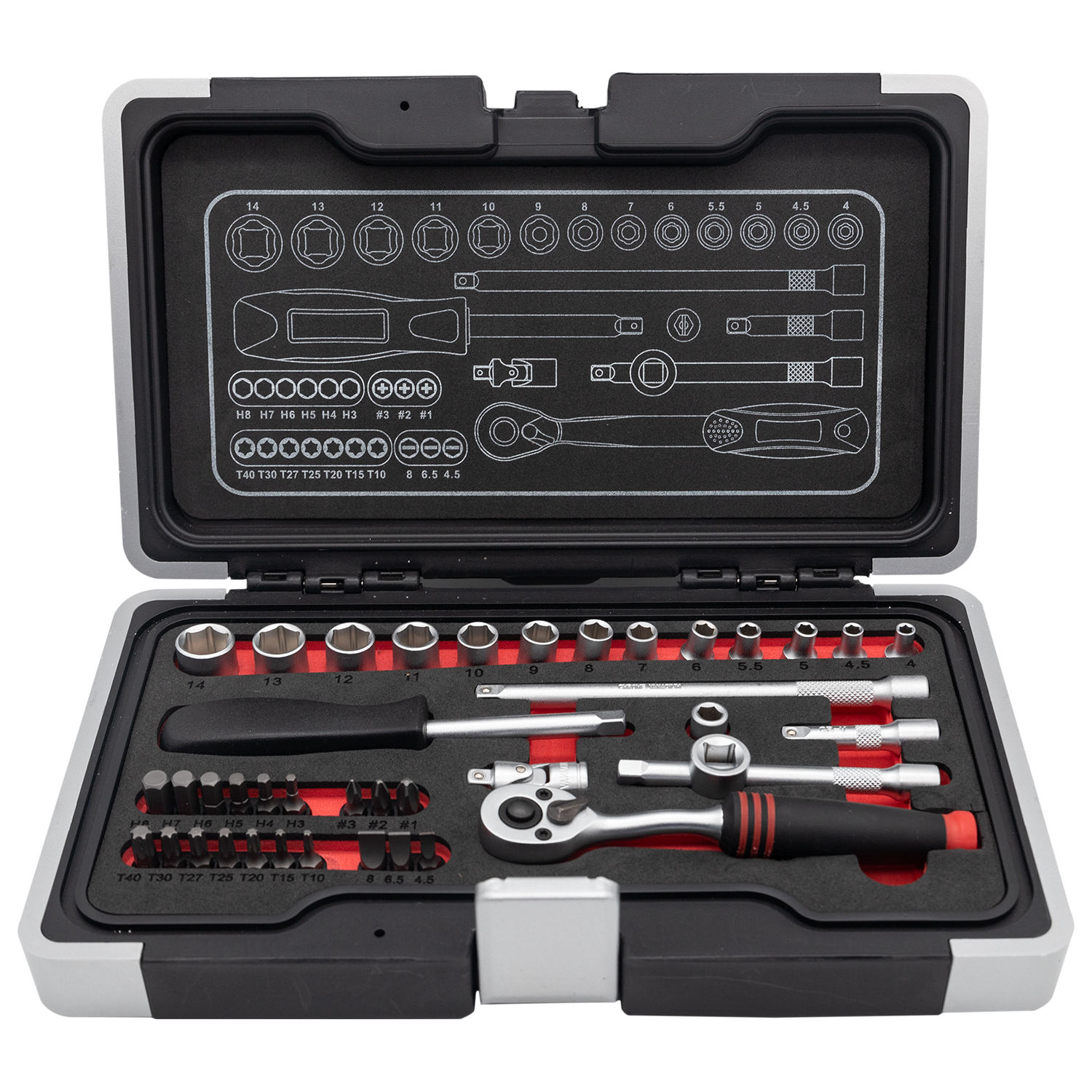
M6902701 · 40 pcs 1/4″
1.39 kg
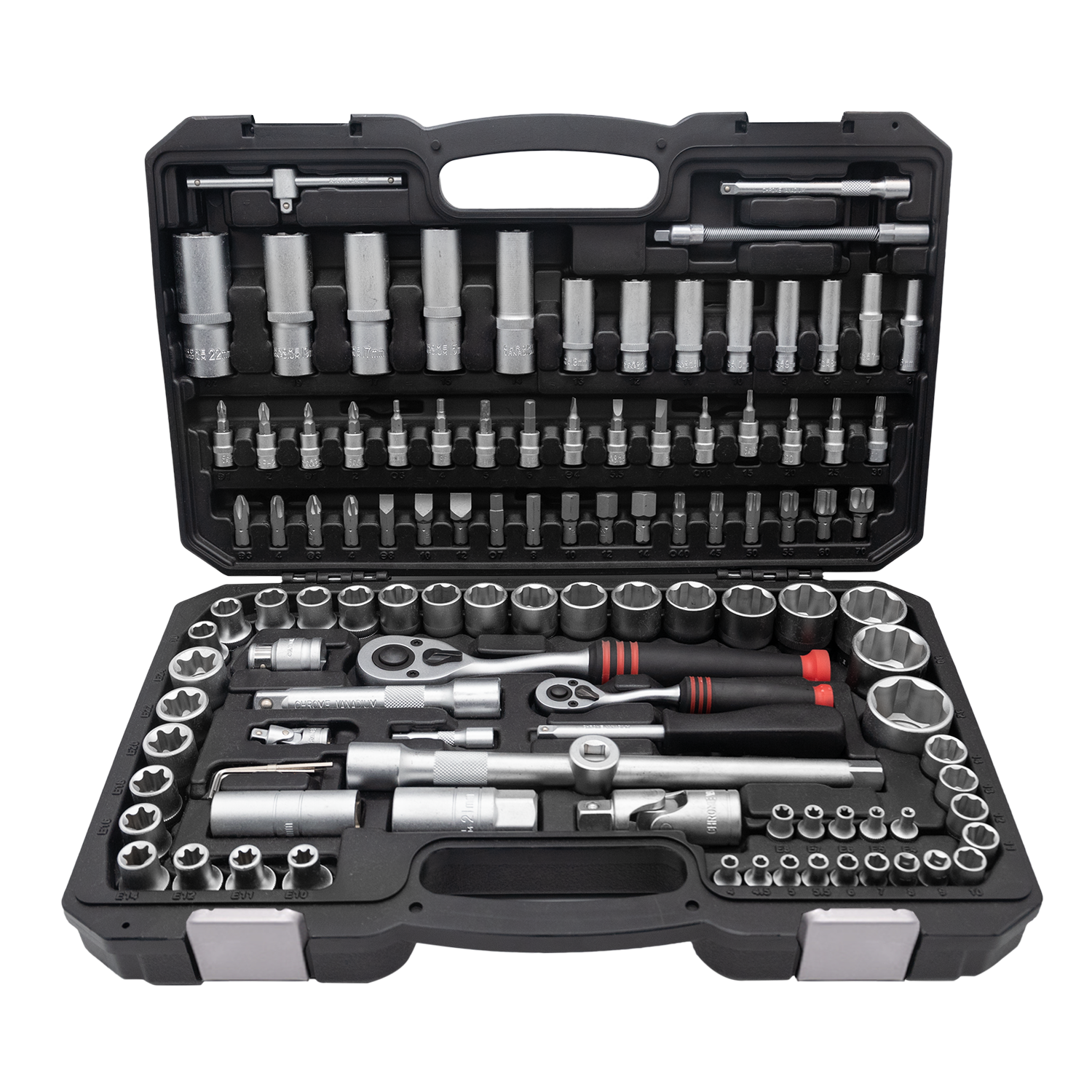
M6900703 · 109 pcs
6.31 kg
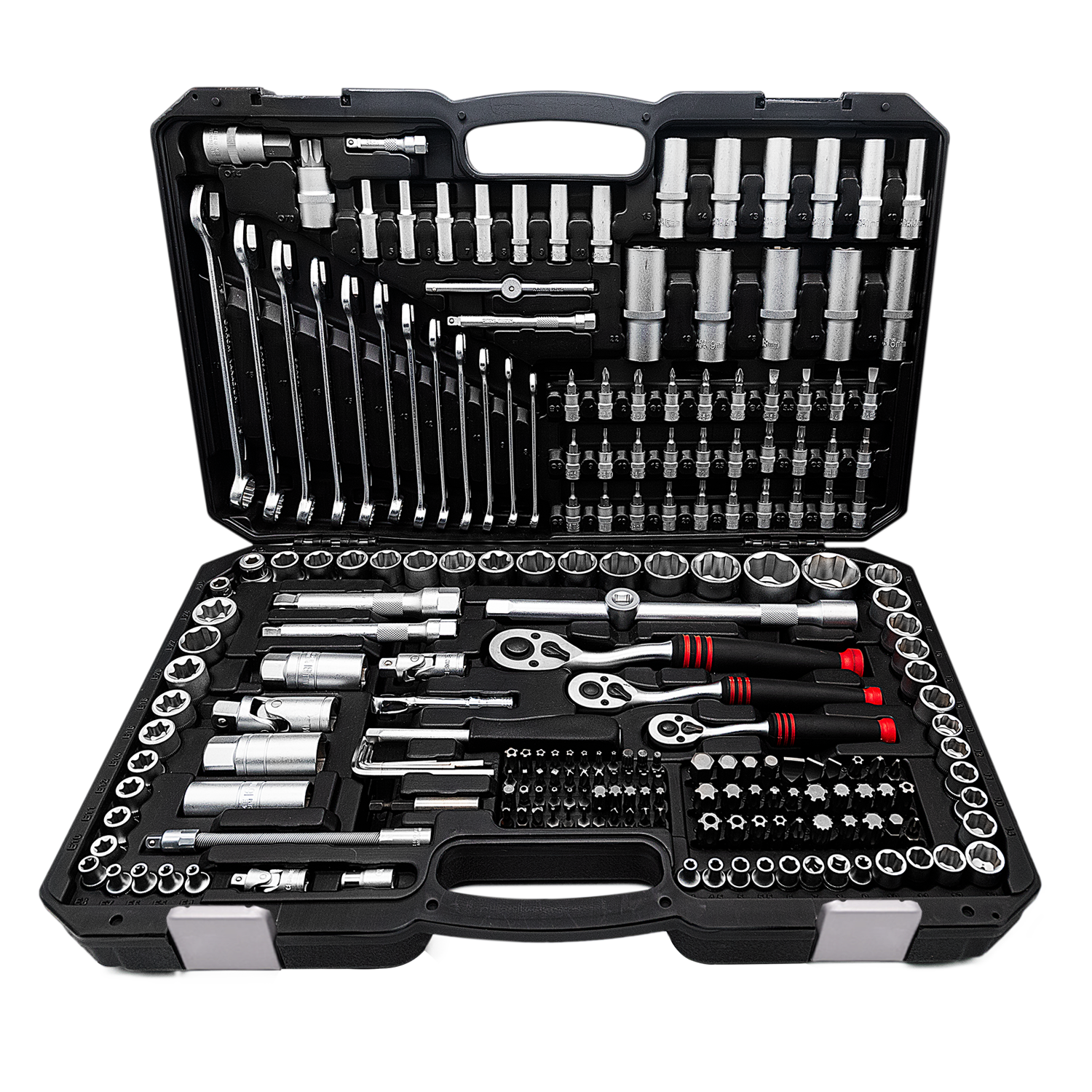
M6901201 · 217 pcs
10.10 kg
Range: 0.35 to 10.63 kg per set, median 2.93 kg. Cartons 0.4 to 19.2 litres, median 5.5 litres.
Representative platforms, by what they solve
The M6900-series designation runs across the range, and the useful way to read it is by the problem each platform was built to answer rather than by piece count alone.
- Maximum versatility per case. The 109-piece M6900703 carries super-lock sockets, deep sockets, E-sockets, 16 bit sockets, extension bars, a universal joint and a 72-tooth ratchet across two drive formats in a 420 × 250 × 85 mm carton at 6.31 kg. It is the platform most brand programmes should look at first: broad enough to serve as a workshop set, compact enough to pallet economically.
- Three drives, one case. The 172-piece M6901001 spans 1/4″, 3/8″ and 1/2″ with super-lock and deep super-lock sockets, star sockets, 30 bit sockets and wobble extension bars — the entry point to the master band at 8.45 kg.
- The flagship. The 217-piece M6901201 is the fullest configuration in the range at 10.10 kg in a 510 × 310 × 85 mm carton. A prestige and workshop product rather than a volume one.
- Volume position. The 40-piece M6902701 at 1.39 kg and the 27-piece M6900101 at 1.11 kg sit where distributors move pallets. Small cartons, high units per container, fast sell-through.
- Access-constrained work. The 24-piece stubby M6901601 at 0.43 kg, and the bit-led 39-piece M6902603 at 0.35 kg — the lightest platform in the range.
- Spline programmes. The 60-piece spline M6903301 at 5.55 kg, for markets specifying multi-tooth drive rather than hex.
- Metric and imperial in one set. The 79-piece M6900506 in 3/8″ drive carries both size families — the configuration to look at for a market that will not commit to one.
- Tool-inclusive. The 80-piece M6900802 adds a quick-release bit holder and bit adaptor to the socket complement, at 5.36 kg.
The distribution is deliberate. Sets in the 19–49 piece band represent approximately 65% of the range — the volume position, the set a master distributor moves by the pallet. The 172–217 piece masters are workshop and prestige products carrying genuine but considerably thinner demand. New brand programmes are generally best served proving sell-through in the small band, with the master set following.
The carton data is a landed cost input. Set weight and carton volume determine cartons per pallet, pallets per container, and cost per landed set. Twelve millimetres of added case height can remove a layer per pallet and remain invisible until the freight invoice. Pallet plans are re-run before tooling is committed.
Starting from a proven platform means drawings exist, components are qualified, the production sequence is established, and tooling may already be in place. Browse the full catalogue or view all socket sets.
The record
Programme management is invisible when it functions. No escalation. No call outside business hours. No choice between a late shipment and a compromised one.
The set arrives.
The methods that produce that outcome remain internal. The record does not.
When the customer’s date moved

A recent programme carried a delivery date of 26 August. Production ran to schedule, inspection passed, the set was packed on time. The customer’s own commercial position then changed, and the goods were required early — urgently.
Nothing had failed in manufacturing. The exposure sat entirely downstream of production, which is precisely the category of problem a components supplier cannot address.
The logistics were rebuilt around the revised date, the disruption was absorbed on this side rather than returned up the chain, and the shipment moved by air.
The customer’s date held. They were not required to trade the launch against the cost of protecting it while the clock ran.
A supplier of parts discharges its obligation the moment the parts conform. Everything subsequent becomes the buyer’s exposure. HaurYueh treats the obligation as closing when the goods are where they are required, on the date committed.
The expensive, unglamorous middle sits on this side of the relationship.
Reproducibility across reorders
For a brand owner this outranks any single specification on any single component.
The end user never compares a set against a drawing. They compare it against the set purchased eighteen months earlier — the finish, the mass, the engagement of the ratchet, whether the chrome matches. A second order that differs subtly from the first inflicts more brand damage than a second order that ships slightly late.
Holding a set consistent across reorders, through separate material batches and separate production windows, is a controlled outcome rather than a fortunate one. Batch-to-batch stability is a deliverable in its own right.
Single-point accountability
A socket set passes through many stages, and one of them will eventually produce a deviation. When it does, one company answers for it.
That is not the universal experience of sourcing a set. Components from one contact, case from another, packaging from a third, each holding a plausible account of why the delay belongs elsewhere — and the buyer becomes the programme manager by default, at several thousand miles and one time zone too many.
Here the deviation is established, resolved and reported. You receive an outcome, not an argument.
Six questions for a procurement review
Applicable to any Taiwanese socket set supplier, including this one.
- Name the longest-lead item on my parts list. Answerable in one sentence by a supplier who has scheduled the programme. Requiring investigation by a supplier who has priced it.
- Who owns the case tooling, and can it be adapted rather than rebuilt? The largest single cost lever in the programme.
- DIN or ANSI, and what changes downstream if the standard changes? A competent answer addresses tooling, not drawings.
- How is finish consistency verified across the assembled set rather than component by component?
- Cartons per pallet and pallets per container, for this exact configuration. A supplier holding these figures has modelled your landed cost.
- What governs the reorder? Identical tooling, identical qualification, identical finish reference.
The set is a schedule in a chrome finish
Everything in a socket set programme that can be specified — alloy, hardness, drive tolerance, plating thickness — is a solved problem, and Taiwan solves it as a matter of routine.
What remains is the element that cannot be drawn: forty manufacturing routes, six clocks, one container, and an end user who will judge the entire programme on whether the extension bar matches the sockets beside it and whether the set arrived the week it was committed.
That is the work. It was never the socket.
Serving strangers to absolute satisfaction. Every programme since 1976 has been run to that standard.
Frequently asked questions
What is the minimum order quantity for a custom socket set? MOQ varies by product, production method, packaging and branding requirement. For a full custom socket set programme the working reference is 1,000 sets, negotiable — particularly where a programme adapts an existing platform and tooling is already in place. Customised logo or label printing generally requires at least 300 sets.
How long does custom socket set manufacturing take? Typically 90 to 180 days. The spread is governed by tooling: adaptation of existing tooling with new artwork sits at the fast end; new case tooling, forging dies or a new ratchet mechanism sits at the slow end.
Is tooling payable up front? Tooling cost is amortisable. Once the mould is complete it serves both low and high order quantities, so a first order need not be oversized to justify the tool. Programmes commence against a 30% deposit.
Can new blow mould case tooling be avoided? Frequently. HaurYueh holds proprietary blow mould case tooling, and where an existing tool can be adapted to carry a partner’s set, this has protected partners to the value of up to US$10,000 against new tooling development.
What does HaurYueh manufacture? Professional hand tools on an OEM and ODM basis, from Taichung, Taiwan, on a manufacturing lineage beginning in 1976. Socket set programmes are taken from concept or proven platform through development, design and artwork, production, quality control and export, delivered as a finished branded set built to DIN or ANSI as the market requires. The wider range also covers wrenches, bits, hex keys, screwdrivers, pneumatics and power tools.
How are ratchets tested? On HaurYueh’s own ratchet torque testing equipment, in house, under both functional cycle testing and destructive testing to failure — rather than against a supplier certificate on the component carrying the majority of warranty exposure.
Which standards are supported? Both DIN and ANSI. The selection belongs before tooling, because socket geometry differs between the families and drives the case cavity, carton and pallet plan.
How many artwork revisions are included? Three rounds as standard — case and clamshell design, colour sleeve, blister, insert, logo placement and layout. Artwork carries a release date within the schedule, because print gates packing and packing gates the vessel.
What set configurations are available? 51 proven sets across all three drive formats: 33 sets from 19 to 49 pieces, 11 sets from 60 to 109 pieces, and 7 master sets from 172 to 217 pieces, ranging from 0.35 kg to 10.63 kg per set. Representative platforms include the 27-piece M6900101, the 109-piece M6900703 and the 217-piece M6901201.
Partner with the source
Submit your parts list, target market and sell date. You will receive an assessment of which of our 51 proven platforms sits closest to your specification, whether your case can be carried on existing tooling, which item on your list carries the schedule risk, and what the programme timeline actually is — before a deposit is committed.
Contact HaurYueh · Request a Quote · sales@hauryueh.com.tw · +886 4 2496 6836
No. 32-1, Lane 66, Xiliu Street, Dali District, Taichung City 41263, Taiwan
LinkedIn · Facebook · Instagram
HaurYueh Co., Ltd. (豪越股份有限公司) — Taichung, Taiwan. Manufacturing stability for global tool brands since 1976.